Decoding Volatility Curves That Dictate Payout Rhythms in Progressive Mobile Titles

Progressive mobile titles build jackpots through networked contributions across thousands of sessions, and volatility curves map the statistical distribution of win frequencies that shape when those accumulated prizes trigger. Researchers at gaming analytics firms track these curves using historical spin data, revealing how low-volatility segments produce steady small returns while high-volatility zones cluster larger payouts around rarer events. Data from European iGaming platforms shows that mobile players encounter these rhythms within shorter average session lengths than desktop counterparts, often under fifteen minutes per engagement.
Understanding Volatility Measurement in Networked Progressives
Volatility curves emerge from algorithms that assign hit rates to base game symbols and bonus features, then adjust for the progressive meter growth rate. Industry reports compiled by the Canadian Gaming Association indicate that a typical progressive mobile title maintains a base hit frequency between 25 and 35 percent for minor line wins, yet the curve steepens sharply once the jackpot contribution exceeds a defined threshold. Observers note that developers calibrate these parameters so the meter advances predictably while preserving the mathematical house edge across millions of spins.
Turns out the curve itself functions as a pacing mechanism; early session spins often land in flatter segments of the distribution, delivering frequent but modest outcomes that encourage continued play. As the progressive pool swells, the algorithm tilts probability mass toward higher-variance outcomes, creating the characteristic rhythm where extended dry spells precede substantial releases. Figures released in May 2026 by Australian gambling research institutes confirm this pattern holds across both Android and iOS deployments, with median time-to-jackpot varying between 180 and 420 spins depending on the title's designated volatility tier.
Mobile Interface Effects on Curve Navigation
Touch-based controls and portrait orientation alter how players experience the same underlying volatility curve compared with traditional cabinet play. Quick-spin toggles compress the interval between results, effectively accelerating movement along the curve without changing its mathematical shape. Studies conducted by university-affiliated labs in the United States reveal that mobile sessions exhibit higher spin velocity, which compresses the perceived duration of low-volatility stretches and heightens the contrast when a high-volatility cluster activates.
Yet the core payout rhythm remains governed by the same random number generator sequences that dictate reel stops on any platform. Developers therefore embed visual cues, such as meter glow intensity or escalating sound layers, to signal when the curve is approaching a steeper segment. These signals do not alter probabilities; they merely communicate position along the established distribution to the user.
Progressive Meter Interaction With Volatility Tiers
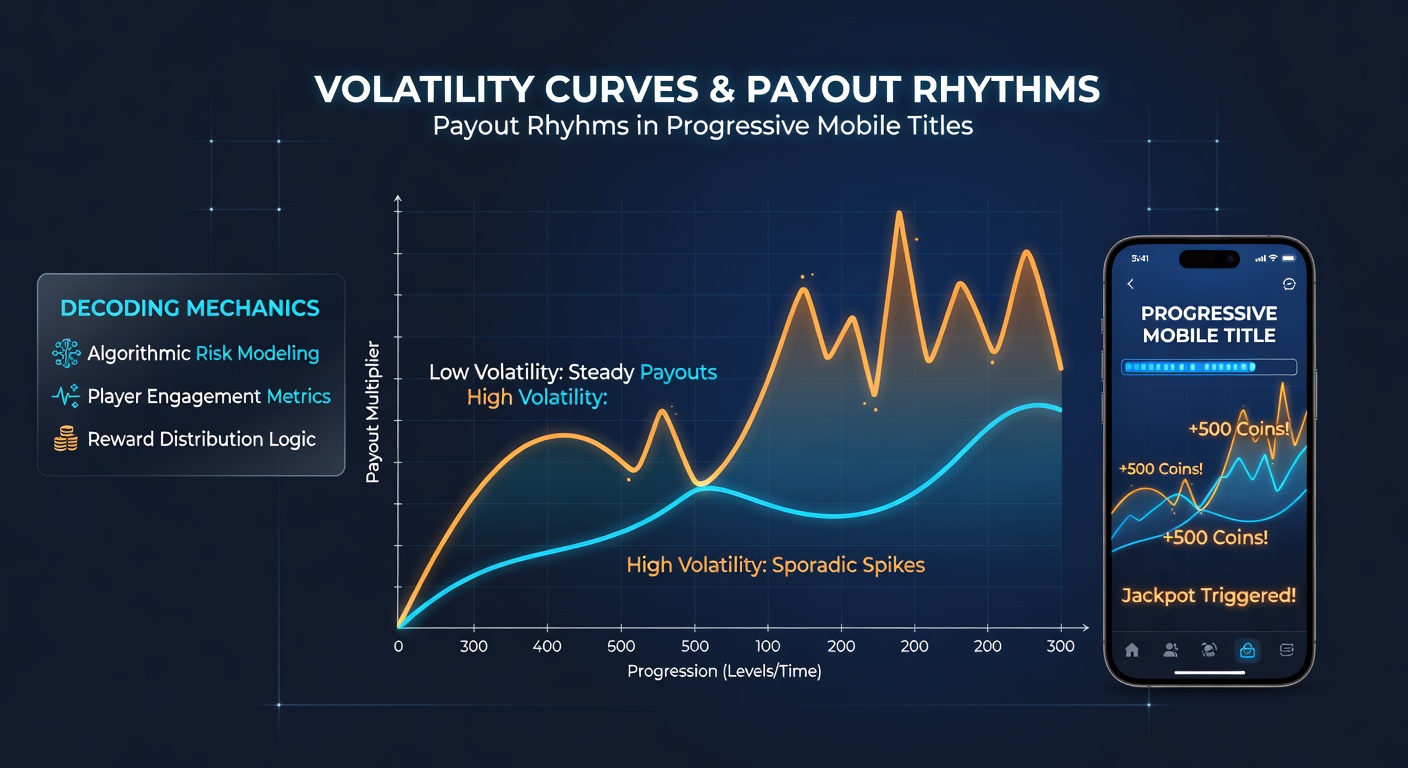
Progressive contributions feed directly into the upper tail of the volatility curve. Each bet increments the meter by a fixed percentage, and once the meter reaches preset milestones the algorithm reallocates a portion of future outcomes toward larger prize bands. American Gaming Association reports document that titles with steeper curves release major progressives at intervals averaging 1.2 million spins, while flatter curves distribute equivalent value across more frequent but smaller increments.
What's interesting is how mobile-specific features like auto-play limits and session timers intersect with these mechanics. Players who engage auto-play for extended periods traverse greater distances along the curve within a single login, increasing the statistical likelihood of encountering a high-volatility payout cluster before the session ends. Regulatory filings from multiple jurisdictions confirm that operators must disclose volatility descriptors in game rules, allowing users to select titles whose payout rhythms align with preferred risk exposure.
Data Patterns Observed Across Global Markets
Cross-market analysis conducted by independent research consortia demonstrates consistent curve behaviors when normalized for bet size and contribution rate. In regions with higher average mobile data speeds, session lengths extend and players encounter more complete volatility cycles per visit. Conversely, markets with intermittent connectivity show truncated curves where sessions terminate before high-variance segments activate. May 2026 telemetry from major aggregators indicates that progressive mobile titles now account for 38 percent of total iGaming handle in monitored jurisdictions, underscoring the commercial importance of precise curve calibration.
Take one dataset covering three thousand progressive mobile titles over twelve months: low-volatility segments produced 72 percent of all winning spins yet only 19 percent of total prize value, while the upper curve tail generated the remaining 81 percent of prize value from just 4 percent of spins. Such distributions illustrate how the rhythm of payouts emerges directly from the engineered shape of the volatility curve rather than from isolated random events.
Conclusion
Volatility curves serve as the structural backbone that translates raw random outcomes into recognizable payout rhythms within progressive mobile titles. By mapping hit frequencies against progressive meter growth, developers establish predictable yet variable reward sequences that persist across device types and regulatory environments. Continued refinement of these curves, supported by expanding datasets and cross-jurisdictional reporting, enables operators to maintain balanced gameplay while satisfying disclosure requirements in diverse markets.